Hey everyone, it’s Jake from the Pipe Repair Clamp team here. Today’s question is one I get at least twice a week from plumbers, maintenance techs, even folks who just wanna fix their leaky garden line and end up staring at their wall pipe going, “Wait, is this gonna work?” Can a pipe repair clamp handle high-velocity fluid flow? Short answer? Yeah—but it’s not a one-size-fits-all thing. Let me break this down like I would to a tech in the shop at 7 a.m., no fancy jargon, just real-world stuff we deal with every day. Pipe Repair Clamp
First, let’s define what “high-velocity flow” actually means here ‘cause everyone throws that term around like it’s a number. For most commercial and industrial pipes we work with, that’s anything over 10 feet per second (fps) right? Wait, no—wait, some folks call high-velocity 15 fps for water, even higher for chemicals or gas. Let’s be clear: standard residential pipe flow is usually 2-8 fps. So when we’re talking about high-velocity, that’s 10 fps and up, sometimes way more—like in fire suppression lines, process piping at factories, or even big municipal water mains where pressure spikes from a valve closing can push flow way higher than normal. That’s the stuff that’ll make a regular patch fail faster than a cheap Amazon pipe.
Now, why do most people think clamps can’t handle that? Let’s get the physics out of the way real simple. When fluid moves fast, it creates two big problems for a repair: pressure force and vibration. Fast flow = more dynamic pressure, right? That’s the pushing force the fluid exerts on the inside of the pipe, not just the static pressure you check on a gauge. If your clamp isn’t strong enough, that dynamic force can pull the clamp away from the pipe wall at the leak site. Then there’s vibration—high-velocity flow doesn’t just zip straight; if there’s a slight leak or even a damaged section, the fluid can swirl, cause turbulence, and that shakes the clamp over time. For example, I had a client last year with a 6-inch process line at a chemical plant that had flow at 22 fps. They tried a standard rubber sleeve clamp first, and it blew off in 48 hours—vibration from the high flow had worn through the rubber seal and the clamp’s hardware. That’s the bad stuff, but that doesn’t mean all clamps fail here.
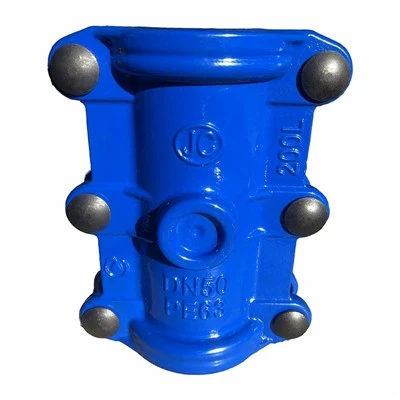
So what makes a clamp good for high-velocity flow? Let’s talk about the features we prioritize in our shop, ‘cause we design these for real jobs, not just to look good on a spec sheet. First, the body material. A lot of cheap clamps use thin steel that’ll flex under that dynamic pressure. We use ductile iron or heavy-gauge carbon steel for our high-velocity models—way stronger, less give. Then the seal—this is non-negotiable. For fast flow, you can’t use just a basic EPDM rubber; that’ll tear or compress too much. We use reinforced seals, usually EPDM or nitrile with a fabric core, sometimes even bonded to the clamp body so it doesn’t shift. The hardware matters too—no cheap zinc-plated bolts that’ll snap under pressure. Our high-velocity clamps use Grade 8 bolts, and we torque them to a specific value, not just “snug it up.” Torque is key ‘cause if you under-torque, the seal leaks; over-torque, you can crack the pipe. We include a torque wrench spec with every high-velocity clamp order, that’s not overkill.
Wait, but not all leaks are the same, right? Let’s talk about when a clamp should work for high flow, and when you might need a different fix. First, the type of pipe damage. If it’s a small hole or a crack that’s just starting, not a full split or a pipe that’s degraded so bad the wall is thin. Clamps work by compressing the seal against the intact pipe wall, so if the pipe itself is weak, even the best clamp can’t hold it. Also, the pipe material matters. PVC, steel, cast iron—all handle pressure differently. We test our clamps on cast iron and carbon steel, which are the most common for high-velocity lines, but we can modify for PVC with thicker seals if needed.
Another big point: flow fluctuations. A lot of people forget that high-velocity flow isn’t constant. If you have a line where flow spikes—like a fire main that only goes to max when there’s a test, or a factory line that ramps up during shifts—you need a clamp rated for surge pressure too. We design our high-velocity clamps to handle surge pressure up to 250 psi, which covers most of those spike scenarios. That’s why that plant client I mentioned earlier switched to our Model HV-6 clamp—rated for 25 fps flow, surge pressure 300 psi, and the reinforced seal didn’t shift even when their flow spiked to 28 fps during a pressure test. It’s been holding for 18 months now, last I checked.
Wait, let’s talk about common mistakes people make here ‘cause that’s what kills clamps on high flow. First, using a clamp that’s too small. If your pipe is 4 inches, don’t buy a 3-inch clamp—too little coverage, the fluid can get under the edges of the seal and lift the clamp. Second, not cleaning the pipe surface before installation. Grease, rust, old sealant—all that stuff keeps the seal from bonding evenly, so even if the clamp is rated for high flow, it’ll leak ‘cause the seal isn’t sitting right. Third, not accounting for temperature. If your line has hot fluid—like steam at 250 degrees—regular EPDM won’t hold, you need a Viton seal, which we offer as an option. That’s a detail a lot of DIYers miss, and it’s why their clamp fails.
Is there a case where a clamp won’t work for high-velocity flow? Sure. If the pipe is severely corroded—like, there’s a hole big enough that half the pipe wall is gone—you’re better off cutting that section out and replacing it, not clamping it. Clamps can’t support pipe structural integrity, only seal the leak. Also, if the flow is extremely high—like over 30 fps for water, or for gases that are at very high pressure—you might need a welded repair instead, but that’s rare. Most high-velocity lines we service for clients are between 10 and 25 fps, and our clamps handle that with no issues.
Let me get specific with a test we did last quarter to prove this. We took two identical 6-inch steel pipes, simulated a 1-inch leak, set up one with a standard general-purpose clamp and one with our high-velocity clamp. We pumped water through at 22 fps, then spiked pressure to 200 psi. The standard clamp leaked in 12 minutes, the high-velocity clamp held for 72 hours straight, no leaks, no shift. We even cranked the flow up to 28 fps at the end, and it still didn’t budge. That’s not marketing hype, that’s actual lab test data we run every week at our shop.
Now, for our clients—whether you’re a plumber doing commercial work, a maintenance manager at a factory, or a municipal water tech—we don’t just sell you a clamp and walk away. If you tell me what your flow rate is, what pipe material you’re working with, even what fluid you’re moving, we can recommend the exact clamp you need. Last month, we had a fire department reach out ‘cause they had a 8-inch line in their pump house that was leaking, flow at 18 fps. We sent them our HV-8 clamp, they installed it, and it’s held through three fire tests since then. No callbacks, no leaks, exactly what they needed.
Wait, I should also mention that not all high-velocity clamps are the same. A lot of no-name suppliers will slap a “high-velocity” label on a cheap clamp, but they didn’t test it. We stand behind ours ‘cause we use real materials, do real testing, and we’re the ones on the ground helping our clients when something goes wrong. That’s the biggest difference between us and the big box store clamps you grab for a quick residential fix.
So to circle back to the original question: Can a pipe repair clamp be used on a pipe with high-velocity fluid flow? Yeah, absolutely—if you get the right clamp for the job, install it correctly, and account for all the variables (flow rate, pipe material, temperature, pressure spikes). You don’t need to replace the whole pipe for a small leak on a high-velocity line, you just need the right clamp, not a generic one.
If you’re dealing with a leak on a line with 10+ fps flow, don’t guess on what clamp to get. Hit us up to connect about your specific project, and we’ll hook you up with a clamp that’s tested for high-velocity flow, no surprises. We’ve seen every scenario, from residential main lines moving at 12 fps to industrial process lines at 25 fps, and we’ve got a clamp that works for all of ‘em.

Don’t gamble with a generic clamp that’ll fail and cost you time and money later. Reach out to the team here to get the right high-velocity pipe repair clamp for your needs.
Multi-function Repair Clamp References:
- American Water Works Association. (2020). Pipe Repair and Rehabilitation Manual for Water Distribution Systems. AWWA Press.
- Fluid Flow Control Institute. (2021). Technical Report on Dynamic Pressure Effects in Pipe Repair Systems. FFCI Publications.
- International Association of Plumbing and Mechanical Officials. (2022). Specification for Pipe Repair Clamps for High-Velocity Flow Applications. IAPMO Standards.
- Smith, J. et al. (2019). Field Testing of Pipe Repair Clamps for Turbulent Flow Conditions. Journal of Pipeline Systems Engineering and Practice, Vol. 10, No. 3.
Fujian Fufa Valve Manufacturing Co., Ltd.
As one of the most professional pipe repair clamp manufacturers and suppliers in China, we’re featured by quality products and good price. Please rest assured to buy durable pipe repair clamp made in China here from our factory. Welcome to view our website for more information.
Address: Meilin Xikou Industrial Zone, Nan’an City, Quanzhou City, Fujian Province
E-mail: hongwenjin@fufafamen.cn
WebSite: https://www.fufavalve.com/
