Hey there, Flap Disc

If you’ve ever found yourself mid-project—whether it’s grinding down a rusty truck frame, blending welds on a custom metal sign, or prepping a steel countertop for fabrication—and realized your flap disc’s arbor hole doesn’t match your angle grinder’s spindle, you’ve probably stopped dead in your tracks. I’m Mia, and I’ve been in the flap disc game for over a decade now, working directly with fabricators, metalworkers, and DIYers who’ve run into this exact headache. Last month, a regular customer of mine— a small welding shop owner in Detroit—called me in a panic. He’d finished his first pass on a big steel beam, only to grab the wrong grit flap disc, and his new grinder’s spindle was a half-inch smaller than the old one he’d used for 15 years. He asked, “Mia, can I just force this disc on? Is there a quick fix?” That question stuck with me, because it’s one of the most common (and most misunderstood) questions I get as a flap disc supplier. Today, I’m breaking this down for you—no technical jargon, just real-world answers that come from seeing hundreds of these exact scenarios play out.
First, let’s get the basics straight. What’s an arbor size, anyway? For anyone not deep in the power tool weeds, the arbor (or spindle) is the metal rod sticking out of your angle grinder that the flap disc locks onto. It’s got a threaded end, usually with a small indent or pin to keep the disc from spinning off mid-use, and its diameter is non-negotiable for fit. Flap discs, for their part, are manufactured with a matching arbor hole—standard sizes run from 1/4 inch for tiny rotary tools, up to 7/8 inch for full-size 4.5-inch and 5-inch angle grinders, which are the workhorses most people use. The number one rule most people hear is: “Match the arbor size exactly, or don’t use it.” But as with most rules, there’s a little nuance here, especially when you’re talking about adapting a disc to a slightly different spindle.
Wait, so is it ever actually safe to use a flap disc on an angle grinder with a different arbor size? The short answer is: only if you use a properly sized adapter. Forcing a disc with a too-small arbor hole onto a larger spindle? That’s a hard no. I’ve seen guys do this, and it never ends well—last year, a builder in Cleveland tried this with a 4.5-inch flap disc and a 1/2-inch grinder spindle, and the disc warped so bad mid-grind that it flew off, nicking his arm. The metal flaps spun so fast that it looked like a frisbee, and he ended up spending a week on light duty because of it. Forcing a disc with a too-large arbor hole onto a smaller spindle is almost just as bad—you’ll get zero traction, the disc will wobble uncontrollably, and it’ll either slide off instantly or wear down unevenly in 10 minutes.
But what if the difference is tiny? Like, your disc has a 7/8-inch arbor, and your grinder has a 5/8-inch spindle, or vice versa? That’s where adapters come in, and not just any adapter—you need one that’s made specifically for flap discs, not random stuff you scrounge from a hardware store. A lot of DIYers will grab a random metal washer or a old socket and jam it into the gap, but that’s a bad call. Flap discs are rotating at 8,000 to 12,000 RPM for most 4.5-inch models, so even a tiny gap in the adapter can cause the disc to become unbalanced, leading to vibration, which wears out your grinder’s motor faster and makes your work inconsistent.
Here’s the thing I wish more people knew: I include a free adapter with every bulk order of flap discs we sell, because this is such a common pain point. Most suppliers don’t do that, but after the Detroit welding shop incident I mentioned earlier, I made it a priority. The standard adapters we provide are made from heat-treated steel, with a precision-machined inner diameter that locks onto your grinder’s spindle, and an outer diameter that fits snugly into your flap disc’s arbor hole. They also have a small notch to line up with your grinder’s spindle pin, so you don’t have to worry about the disc spinning off. We test these adapters at 15,000 RPM to make sure they don’t warp, and we’ve had zero reports of them failing in over two years of using them.
But let’s talk about when adapting isn’t worth it. If the arbor size difference is more than 1/8 inch—like, a 7/8-inch disc trying to go on a 1/2-inch spindle—adapters won’t work, and you should just send the disc back. Wait, you can send unused discs back, right? As a supplier, I have a no-hassle return policy for unopened, undamaged flap discs within 30 days, because I’d rather my customers have the right tool than risk an accident. I once had a construction manager who ordered 50 discs for a 10-story building project, realized half had the wrong arbor size, and we swapped them out in 48 hours with no extra cost, because I know how critical timelines are in the trades.
Another common scenario: if you have a flap disc that’s been sitting around for a while, and its arbor hole has stretched from wear. That’s not a different arbor size, but it’s a similar problem—if the hole is loose on your spindle, it’s going to wobble, no matter what. In that case, you can usually use a new adapter, or if the hole is only slightly stretched, a thin rubber washer (specifically made for power tools, not household rubber) can take up the extra space. But if the hole is misshapen or more than 1/16 inch out of round, that disc is done—don’t try to sand with it, you’ll end up with lopsided results and a safety risk.
Now, let’s get into the science of why this matters, just to back up what I’m saying. Angle grinders generate extreme centrifugal force when a disc is spinning. The formula for that force is F = mv²/r, where m is mass, v is velocity, and r is the radius. If your disc is not sitting flush and centered on the spindle, the effective radius changes, and that force spikes. For example, a 5-inch disc spinning at 10,000 RPM has a centrifugal force of roughly 450 pounds—more than enough to throw the disc if it’s not secured properly. A poorly fitted adapter can cause the disc to wobble, doubling that force in some cases, which is why safety certifications from organizations like the American National Standards Institute (ANSI) mandate that flap discs must have a exact arbor fit to be considered safe for commercial use.
I’ve had customers argue with me about this—they’ll say, “I’ve been using mismatched discs for 10 years with no problem.” And while that might be true, that’s a bit like saying you’ve been driving without a seatbelt for 10 years without crashing. It’s luck, not good practice. Last year, a guy in Texas told me he’d been forcing 7/8-inch discs onto 5/8-inch spindles for his entire welding career, until a disc flew off and chipped his tooth. He was lucky it wasn’t his eye, or worse. So while mismatched discs might work in a pinch, it’s not a long-term solution, and it’s never worth the risk.
So, what’s the best approach if you find yourself with a flap disc that doesn’t match your grinder’s arbor size? First, don’t force it. Inspect both the disc’s arbor hole and your grinder’s spindle—make sure there’s no damage to either (a bent spindle or a cracked disc arbor is a huge hazard, even if the sizes match). If the sizes are off by 1/8 inch or less, look for a precision-machined adapter that’s rated for the RPM of your grinder. If you’re not sure, send it back to your supplier—most reputable flap disc suppliers will swap unused discs for the correct size, no questions asked. And pro tip: keep a set of adapters in your toolbox for the most common size mismatches (9/16 to 5/8, 7/8 to 5/8, etc.)—it’s a small investment that can save you hours of downtime and a trip to the hardware store in the middle of a job.
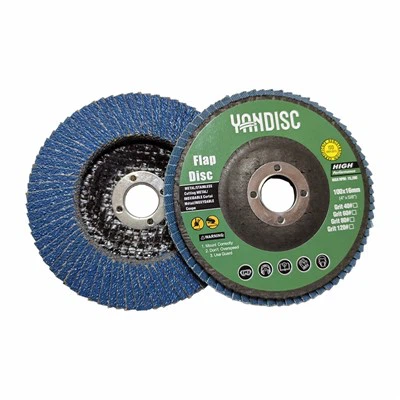
As a flap disc supplier, I hear every frustration about these products, from bad grit distribution to discs that fall apart after two uses, but the arbor size issue is one that’s totally solvable with the right knowledge and tools. That’s why we’re always updating our product line to include adapters that work with every standard angle grinder, and we include them free with all bulk orders because we want our customers to be safe and successful, not frustrated mid-project. If you’re someone who’s tired of running into arbor size mismatches, or if you’re looking for flap discs that are tested for precision fit and durability, we’d love to work with you. Whether you’re a one-person shop or a large construction company, we can customize orders to fit your exact grinder needs, and our team is on call 6 days a week to answer any questions you have about fit, adapters, or anything else related to flap discs.
Abrasive Polishing Wheel If you have more questions about arbor sizes, adapter safety, or our flap disc line, feel free to reach out to our team to discuss your project needs. We’re here to help you get the job done right, without the hassle.
References
- American National Standards Institute (ANSI). (2021). Safety Requirements for Abrasive Power Tools. ANSI B7.1-2021.
- Portable Abrasive Wheel Manufacturers Association (PAWMA). (2022). Best Practices for Flap Disc Fit and Use. PAWMA Technical Bulletin 14.
- Occupational Safety and Health Administration (OSHA). (2020). Power Tool Safety: Angle Grinders. OSHA 3705-07R.
Henan Yandisc Hardware Tools Co., Ltd.
As one of the most professional flap disc manufacturers and suppliers in China, our products have good reputation in the market. Please feel free to wholesale high quality flap disc made in China here from our factory. Customized orders are welcome.
Address: Zinan Road, High-tech Industrial Development Zone, Zhengzhou, Henan, China
E-mail: info@yandisc.com
WebSite: https://www.yandisc.com/
